Getting Better Clients / Lesson 7
The Red Flag
By Ron Stauffer
The warning signs that tell you a project is unsafe to continue and why walking away can save your business and your sanity.
Enroll free to watch this lesson. The full transcript is available below.
Enroll Free
Enter your email to unlock every video in this course. No account, no password, no payment.
Transcript
The red flag means conditions are too dangerous to continue. Track is not safe to proceed at any speed. Drivers must stop on the track. This is the red flag. This is the bad one. This is the one where you say, do not pass. Go do not collect $200. Don't slow down. Stop immediately, halt everything.
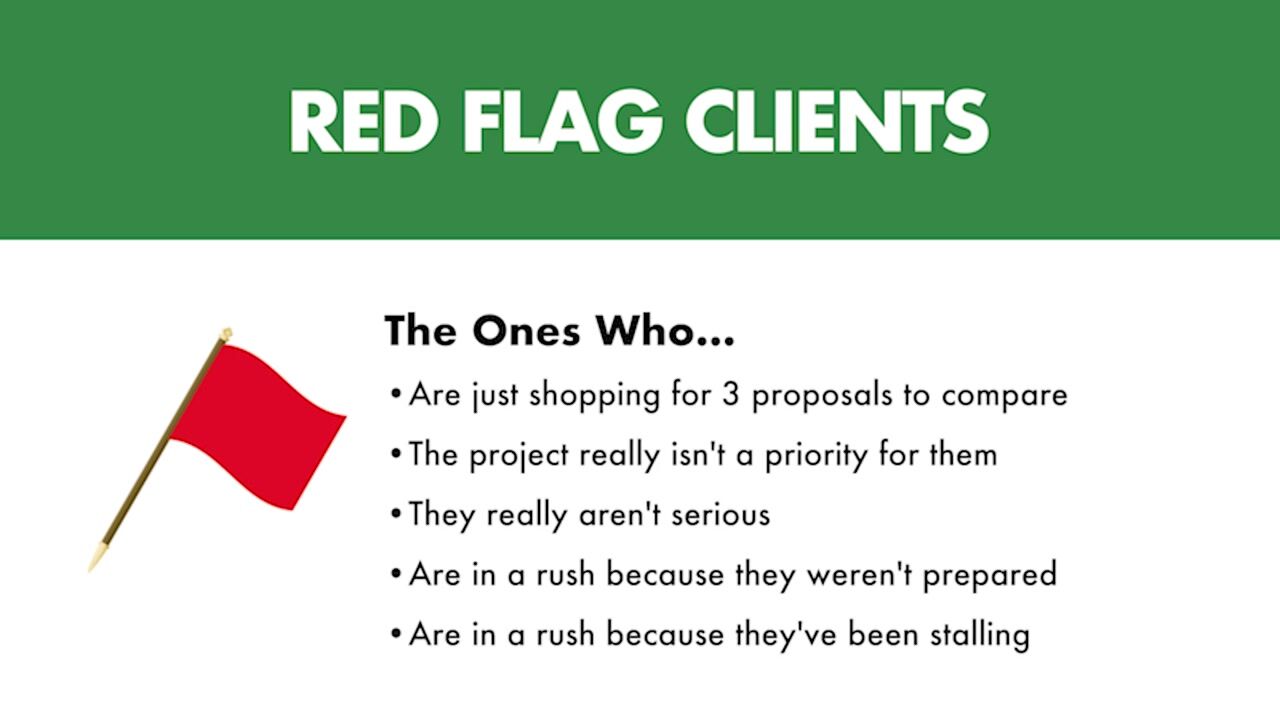
The red flag clients are just bad clients waiting to happen. They're the ones who are just shopping for three proposals to compare. The project really isn't a priority for them, or they're really not serious. They're in a rush because they weren't prepared, or they've been stalling. They've obviously never done this before and don't understand what it takes. They don't respect the process, their to-dos or the project date. They want you to fix someone else's mess quickly, or they're looking for someone else to blame when it turns out they're stuck in a trap.
I've noticed that people use the term red flag all the time, but they've never really sat down and written out a list, at least the freelancers I know, of the red flags that they've encountered so that they know how to avoid them in the future. That's a good exercise in your business. Think about the people who have become terrible clients and write out what it is they said, what it is they did to really make it difficult to work with them.
The problem with the red flag clients though, as I've seen over and over again with the freelancers I meet, is that we can all identify them, but we still choose to work with them. Sometimes for some strange reason, we think we can just power through it or they'll change, or we can get over it somehow. Ultimately, they don't respect you or what you do. A lot of times, these are the clients who view you as a tool, not as a creative professional hired for their skill set, but a tool like a hammer or drill or screwdriver. They want to use you to get something done.
These are terrible clients. Red flag clients say things like "I'm a very creative, opinionated, picky person. I know what I like." "Thanks for the proof. Let me see what my family member thinks." "I'm just having the hardest time finding a good web guy." "Oh, I could do it myself, but I just don't have the time." "We have a small budget, but think of the exposure you'll get." "We need this done yesterday." "Can you just train my son to do it?" "I don't like it, but I don't know why." "Can you just send me the files and I'll do it myself?" "Can I come to your office and watch you do it?" "Can you make this go viral?" "That shouldn't be too hard, right?" or "That shouldn't take too long, right?"
Do you recognize some of those? Have you heard those before? Have you worked with people like that before? It's so frustrating when we do that, because as I've said, I have, and I've heard other people say, "I know I saw it coming. I knew I shouldn't have worked with that person, but I was desperate or I needed the money" or whatever reason we give ourselves. You're not desperate. You don't need the money. Listen to what these people are saying to find clues that will tell you that they're red flag clients.
One thing I've noticed is typically a red flag client won't say something immediately upfront. It's usually a little throwaway comment in an unguarded moment where they say something as an afterthought, and I think, "Ooh, that's bad." Some examples could be comments like "Well, our last guy..." and then you start to figure out that they sued their last guy or their last guy fired them as a client.
It's like when you're in an interview for a job. Sometimes your interviewer will ask you questions about your last job because they're trying to figure out what terms you left that job on, and they want to hear and see how you're going to talk about your previous employer. Why? Because that's a clue into how you're going to treat them as your employer. So if your potential employer asks about your previous job and you badmouth him and go on about what a terrible boss he was, this new potential boss is going to say, "I don't know that I want to hire this guy because he keeps badmouthing the last guy that he worked for."
The same is true with freelancers. If you start to get a sense of the last webmaster or the last graphic designer or the last photographer, you might start to wonder what the problem was that made it so they're not working with that person anymore. Maybe that person decided to stop working with them because they're a terrible client.
Listen for these clues as you talk and you listen and you learn and you get to know more about this potential client. Keep your ears open for those comments, especially the unguarded comments, because that's where the red flags are the most obvious. You want to avoid red flag clients at almost any cost, because if you don't and you take them on, they will become clients from hell.